Saturday, February 21, 2015



Friday, February 20, 2015
ruby and uganda
magic
red dust
shadows
voodoo
prayer
woods
memory
ghosts
loss
burden
demons
secrets
healing
poetry
injustice
heat
rituals
evil
redemption
faith
horror
beauty
power
ripe
dark
pastoral
haunting
lush
I am reading a book called Ruby by Cynthia Bond. Above are just some of the words that describe where my head has been while turning the pages of this powerful tale. At the same time I have been reprinting some of my early Ugandan work.
I can't deny - and have actually embraced - the sensibilities that have been aroused by the place and the people portrayed by Bond… by the smells and the sounds and the rhythms and the thick east Texas air that simply remind me, more often than not, of Uganda.
So often music and literature profoundly impact the work I happen to be making. I love that.


red dust
shadows
voodoo
prayer
woods
memory
ghosts
loss
burden
demons
secrets
healing
poetry
injustice
heat
rituals
evil
redemption
faith
horror
beauty
power
ripe
dark
pastoral
haunting
lush
I am reading a book called Ruby by Cynthia Bond. Above are just some of the words that describe where my head has been while turning the pages of this powerful tale. At the same time I have been reprinting some of my early Ugandan work.
I can't deny - and have actually embraced - the sensibilities that have been aroused by the place and the people portrayed by Bond… by the smells and the sounds and the rhythms and the thick east Texas air that simply remind me, more often than not, of Uganda.
So often music and literature profoundly impact the work I happen to be making. I love that.
Wednesday, February 18, 2015
meet fred and sarah
At this end of this month, Fred will be making his third trip to SMK. The children love him and can't wait to get their arms around him once again!


Here's the scoop on this special man:
Fred Grossman is a clinical psychologist who transferred his
practice from Kansas City to Portland,
Oregon in 2010. He has been in practice since 1977.
In addition to his practice, Fred has volunteered in a variety of settings including a
woman’s shelter, an AIDS clinic and an adolescent diversion program. Fred has
also worked with clergy to provide a more effective delivery system to
parishioners. Fred has traveled to Africa twice to volunteer for Change the
Truth. He is enjoying giving his time as a Board Member of the
organization.
In his leisure, Fred enjoys hiking, traveling and spending
time with his wife Cheryl and his children Erica, Ian and Dennis.
Sarah is a nurse who was in Uganda last June for the first time. She fell head over heels in love with the country and its people and didn't waste any time finding a way to return. On March 1st, she will make her first trip with CTT. We are so happy to welcome her into the CTT family!
Here's the scoop on Sarah:
This will be my second time in Uganda, the first being a
medically focused trip at Lacor Hospital in Gulu. As a registered nurse,
my focus will be in health education on an age-appropriate level and fun-oriented manner, covering two main topics: infection control and burn
prevention. Having experienced a Ugandan hospital for three weeks, it became
apparent that education on these two topics could vastly cut down on injuries,
illness, and hospital visits. I'm especially excited to be working with children
at St. Mary Kevin's. Ugandan children have so much light and joy in their
hearts despite their situations, it's hard not to be filled with smiles and
happiness.
Sunday, February 15, 2015
dave jordano: detroit
My husband, Eddie, grew up in Detroit. We used to go there often - until his folks made the move to Florida in the 1980's. The motor city has been through tremendous change since I first went there to meet my then future in-laws in 1972.
Photographer Dave Jordano also grew up in Detroit. The wonderful photographs he's been making of his hometown are part of an ongoing body of work he calls "Unbroken Down."
Here is Jordano's statement about the series:
Detroit is my hometown, but I've been gone for over three decades. As a child growing up, my dad, who worked all his life for General Motors, used to joke and say that we had motor oil in our veins. Even after all these years, I still believe there is some small truth to what he said.
These photographs are my reaction to all the negative press that Detroit has had to endure over the years. I wanted to see for myself what everyone was talking about, and like everyone else I was initially drawn to the same subjects that other photographers were interested in; the crumbling factory interiors, the empty lots and burned out houses that consume a third of the city, and the massive abandoned commercial infrastructure. It took me a week of shooting this kind of subject matter to make me realize that I was contributing nothing to a subject that most everyone already knew much about, especially those who had been living there for years.
To counter this, I began looking at the various neighborhoods within the city and the people who live within them. This human condition, while troubled, struggling, and coping with the harsh reality of living in a post-industrial city that has fallen on the hardest of times, does thrive, and demonstrates that Detroit is not the city of death and decay that everyone had been reporting in the media, but one that shows signs of human activity and movement. However, not withstanding the recent press about Detroit’s efforts to rebound from the depths of ruin, which is in all ways promising, my focus continues to rest on the current conditions that affect many of the poor and marginalized people whose fate will be drawn out in the ensuing months and years to come, and not in short capsulated 30 second news sound bites.
Whatever that outcome may be, whether for better or worse, I’ve found that most Detroiter’s wear their pride for the city they live in much like a badge of courage, defying all odds, openly admitting that if you can survive here, you can survive just about anywhere.


Photographer Dave Jordano also grew up in Detroit. The wonderful photographs he's been making of his hometown are part of an ongoing body of work he calls "Unbroken Down."
Here is Jordano's statement about the series:
Detroit is my hometown, but I've been gone for over three decades. As a child growing up, my dad, who worked all his life for General Motors, used to joke and say that we had motor oil in our veins. Even after all these years, I still believe there is some small truth to what he said.
These photographs are my reaction to all the negative press that Detroit has had to endure over the years. I wanted to see for myself what everyone was talking about, and like everyone else I was initially drawn to the same subjects that other photographers were interested in; the crumbling factory interiors, the empty lots and burned out houses that consume a third of the city, and the massive abandoned commercial infrastructure. It took me a week of shooting this kind of subject matter to make me realize that I was contributing nothing to a subject that most everyone already knew much about, especially those who had been living there for years.
To counter this, I began looking at the various neighborhoods within the city and the people who live within them. This human condition, while troubled, struggling, and coping with the harsh reality of living in a post-industrial city that has fallen on the hardest of times, does thrive, and demonstrates that Detroit is not the city of death and decay that everyone had been reporting in the media, but one that shows signs of human activity and movement. However, not withstanding the recent press about Detroit’s efforts to rebound from the depths of ruin, which is in all ways promising, my focus continues to rest on the current conditions that affect many of the poor and marginalized people whose fate will be drawn out in the ensuing months and years to come, and not in short capsulated 30 second news sound bites.
Whatever that outcome may be, whether for better or worse, I’ve found that most Detroiter’s wear their pride for the city they live in much like a badge of courage, defying all odds, openly admitting that if you can survive here, you can survive just about anywhere.
My hope is that this work will convey in many ways that Detroit is a city made up resilient, strong individuals who have withstood many harsh realities, while all the while clinging to the vanished ideals of an urban oasis that once prided itself as one of the most beautiful and prosperous cities in America, at one time a model city for all others to follow, but one which has now fallen from grace.
This project bares witness to the fact that Detroit is not a story about what’s been destroyed, but more importantly about what’s been left behind and those who are coping with it.
This project bares witness to the fact that Detroit is not a story about what’s been destroyed, but more importantly about what’s been left behind and those who are coping with it.
-Dave Jordano
Thursday, February 12, 2015
Tuesday, February 10, 2015
big sonia: love wins
 |
| Love Wins: Vigil for Reat Underwood and William Corporon, April, 2014 |
Last night Eddie and I held a small fundraiser for the movie "Big Sonia." I've been doing the photography for this indie film, which is being produced by Sonia's granddaughter, Leah Warshawski. Sonia is a friend. I've known her for about 30 years. She's a fascinating, gracious, colorful woman who has lived an amazing life. The film is ultimately about survival - and the fact that in the end, love wins.
I really believe in this project and am hoping enough funds are raised so that the film can be finished before Sonia's 90th birthday in November. Please read the following remarks I gave last night and watch the three-minute trailer for "Big Sonia". If you think you might be interested in donating money toward the production of this film, please let me know. I happen to have the link to the 10 minute trailer we showed last night (it's phenomenal!), and I've been given permission to share it. So I can send that your way, if you like. Any amount of money will help, but if you give at least $250 your name will appear in the credits! You can donate on the website.
A little over 30 years ago, shortly after moving to Kansas City, Eddie and I were invited to a Passover Seder by our new friends Art and Diane Federman. Soon we were going to their house for Shabbat dinner and then again to help build the sukkah. The Federmans quickly became part of our extended family. Every time we celebrated a Jewish holiday at their house, there was always Aunt Sonia – a curvy, petite woman with big hair, a heavy Polish accent, lots of carefully applied make-up, a well-tailored brightly colored suit, a leopard print accessory and plenty of bling. Aunt Sonia was quiet, but when she spoke, every head turned. She always contributed something wise or funny and whip smart at some point during the dinner conversation. She also made a mean gefilte fish.
 |
| Sonia Warshawski at John's Tailoring Shop, 2000 |
I
got to know Sonia even better in the year 2000 when I made her portrait for the
book From the Heart, A Mosaic of Memories. That was the first time I ever
went to her tailoring shop. I was seduced not only by Sonia, but by all the
bits and scraps of herself that adorned the tables, walls, shelves and every
nook and cranny of the small space where she – yes, WORKED – but also HELD
COURT each day from 9 – 5. Sonia dispensed as much advice and good will as she
did sewing services.
When
I heard from the Federmans that there was a movie being made about Sonia, I
jumped at the opportunity to help. I met the producer, Sonia’s granddaughter,
Leah, and talked my way into the job as still photographer. I have believed in
this film from the start, and I am proud to be part of it. I am donating all of
my photographic services, and Eddie and I have made a financial contribution,
as well. We believe in hope, tolerance, respect and love. We think you do, too,
and that’s why we are asking for support of this film.
The
movie being made by Leah is called “BIG SONIA,” which, of course is kind of
funny when you consider that 89-year-old Sonia is only 4 foot 8 (not including
her hair). I have grown to love and admire Leah and her very talented
co-producer, filmmaker and husband Todd Soliday. They are telling Sonia’s story
with humor, wit, style and heart – all qualities that describe the woman
herself.
 |
| Sonia in her car, 2014 |
We’re
very lucky tonight because we get to see a ten-minute trailer for the movie.
Not many people have seen it yet. I think you’ll agree that the portrayal of
this important and special woman – one of the last in Kansas City who continues
to speak publicly about her experience during the Holocaust – is sweet and
tender, yet very powerful. It’s a movie that needs to be seen by a wide
audience. Sonia, the ultimate survivor in every way, preaches tolerance,
respect and love. Which part of our society, and who among us, doesn’t need to be
reminded of the importance of these virtues?
A
coincidence happened this past weekend. (Well, my friend Shea would say there
is no such thing as a coincidence.) Someone put me in touch with Mindy
Corporon. On April13th last year, her 14-year-old son Reat and her father Bill were killed outside the Jewish Community Center in Overland Park.
Simply on their way to Reat’s audition for a singing competition, they were
victims of a hate crime, even though they were not Jewish. The words called out
by the shooter, a white supremacist, were “Heil Hitler.”
When
asked about the shootings last year, Sonia said to anyone who would listen: “We cannot let hate take over love.”
Or,
as another Holocaust survivor, Bronia Roslawowski (of blessed memory), once
told me: “If I am angry and live my life hating, then the haters will have
imprisoned me, and they will have won.”
During
my first email exchange with Mindy on Saturday afternoon, I learned that she
had asked a woman named Sonia Warshawski, who she did not know yet, to speak at
one of the events surrounding the one-year anniversary of the shooting. That’s
when we discovered a whole string of connections.
It
is so meaningful, and I am so honored that Mindy Corporon is here tonight. Her mantras
are “FAITH WINS” and “LOVE WINS.” Well, so were Bronia’s, and
so are Sonia’s. Mindy told me that she and her husband recently introduced
their 12-year-old to the Holocaust during their visit to the Holocaust Museum
in Washington. Their son learned for the first time that millions of people have already been killed and affected because of
the same hate and ignorance that killed his brother and grandfather - and
knowing that his family is not alone is helping him move forward. Mindy and Sonia haven’t met… yet. I believe she and I
were introduced at just the right time, and I’m really grateful for that.
Now Leah, Sonia’s granddaughter, is going to show the trailer. Afterward,
she’ll speak about the film and then answer any questions you may have. You
know why you’re here – to learn about BIG SONIA and to offer financial support
for its production. So after Leah is done, I will ask you to get out your
checkbooks.
Thanks
for coming. This is the first time I’ve ever done anything like this, so you
know it must have a very special place in my heart.
So… please check out the "Big Sonia" website, watch the trailer (and let me know if you'd like to see the longer one) and consider making a donation so the film can be completed. The folks in the room last night were totally won over by the Sonia and by the movie (when the trailer ended, there was applause and cries of "we want to see more!"). I hope you will be won over, too.
Friday, February 06, 2015
grandchildren
 |
| Henry in the backyard |
 |
| Clara strolling her baby |
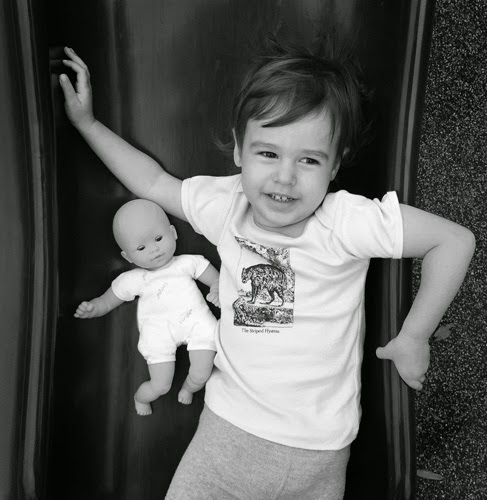 |
| Clara and baby Sandra on the slide |
 |
| Audubon Park |
 |
| Playing hide and seek with Mom |
 |
| Henry under the couch cushions |
 |
| Monster slippers |
 |
| On the staircase |
 |
| Umbrella |
Subscribe to:
Posts (Atom)