"The camera is an instrument that teaches people how to see without a camera." - Dorothea Lange
Showing posts with label Roger May. Show all posts
Tuesday, July 07, 2015
outsider shooting
There's a great conversation taking place over on Roger May's Facebook page. (Roger is the tireless creator, curator and coordinator of the "Looking at Appalachia" photography project.) The lively and intelligent FB dialogue concerns a recent article in Vice Magazine called "Two Days in Appalachia," which is loudly and brashly illustrated by photographer Bruce Gilden - in typical Bruce Gilden style. It has offended many people, particularly those who live in Appalachia - and most especially those who make their own photographs there.
Apparently Vice sent Gilden to the area to do the job. He didn't have much time and chose to spend what time he had in churches and at a festival, making what most of the FB commentaries have called stereotypical and unflattering images. It's not unlike the time Vice sent photographer Alec Soth to Nome, Alaska to do a story. Residents of Nome were up in arms over his insulting and ugly portrayal of the place they hold dear.
Shooting a place as an outsider is a challenging assignment. I know. I've done it many times.
When I go to Uganda this fall, even if it is the ninth time, I will still be making photographs as an outsider. Whenever I travel to my home state of Kentucky to shoot in Appalachia, I am an outsider. When I make pictures for Operation Breakthrough in Kansas City, I am an outsider. Pretty much every self-assigned project I've done as a photographer puts me on the outside looking in: identical twins, Holocaust survivors, the homeless in Portland and Black barber shops to name but a few.
I am a curious person, eager to learn about the people around me - especially those whose life experiences are vastly different from my own. Toting a camera has often given me access, and I've appreciated and savored that over the years. I am acutely aware that it's a privilege when doors are opened to me, and in return, I try to treat my subjects with respect.
Robert Frank was one of the ultimate outside shooters when he made "The Americans." Some felt the pictures were made with empathy and a healthy sense of curiosity; others were offended. When Arbus ventured from her upper middle class NY upbringing into the seedy apartments of those living on the fringes of society, some were appreciative of the look inside while others were appalled that she "exploited" her subjects.
As a photographer, I try not to judge. But, of course, I can't help but show my own interpretation of what's in front of me. Put ten photographers in front of a subject or setting, and, of course, you'll get ten different points of view. Many photographers believe their images are nothing more than "self portraits" because they bring their own baggage to each picture, and if they are any good, those life experiences will show up in the pictures they make. I tend to agree with that line of thinking.
So are Gilden's pictures of church and festival going people in Appalachia self portraits? Were Arbus' pictures simply riffs on who she thought she was? Are mine? Are yours?
Last night I landed in Portland, my second home, for a two-month stay. I guess you could say I'm an outsider here, since I wasn't born and raised here and don't live here full time, but I love photographing here. Within an hour of trudging my suitcase to our small apartment, I made the photograph at the top of this post. Her name is Maria, and she sat alone, thoughtfully slicing away at her small piece of cheese pizza at the place Eddie and I went for dinner. She was so lovely, and the air of sadness around her kept pulling me in her direction. I finally went over to her table and introduced myself. Turns out she speaks no English (and my Spanish is very, very limited), but we managed to make this picture. She pointed to her place, and it is right across the street from where my place is. Her building is low-income housing in a fancy-schmancy part of town. Mine is not. I am intrigued by her and want to know her story. Maybe I'll end up wanting to know the stories of the rest of the residents in her building. Perhaps meeting her on my first night back in Portland was the photo-goddess' way of plopping an idea for a summer project squarely onto my plate.
And yes, I'd be an outsider. Even though I live right across the street.
For my money, it'd be a chance to expand my knowledge of the world and its inhabitants and to touch upon the humanity that connects us all.
I heart photography. Even photography that makes me mad or offends me. Because it's that sense of shared humanity - and thoughtful conversations about it - that make me feel really alive. And make me eager to lift the viewfinder to my eye over and over and over again.
Labels:
Bruce Gilden,
Looking at Appalachia,
photography,
Portland,
Roger May
Wednesday, May 20, 2015
looking at appalachia
Roger May's project, "Looking at Appalachia" is getting some well deserved recognition and praise. I'm very proud that I have some work in the exhibition. Roger is the real deal and is extremely earnest and honest and passionate about what he's doing. The show is just beginning its tour, and the Lens blog at the New York Times is featuring it today. Kudos to Roger and to all the photographers involved.
You can read about it here.
(I'm thrilled that one of my photos is included in the article!)
You can read about it here.
(I'm thrilled that one of my photos is included in the article!)
Wednesday, October 08, 2014
william gedney
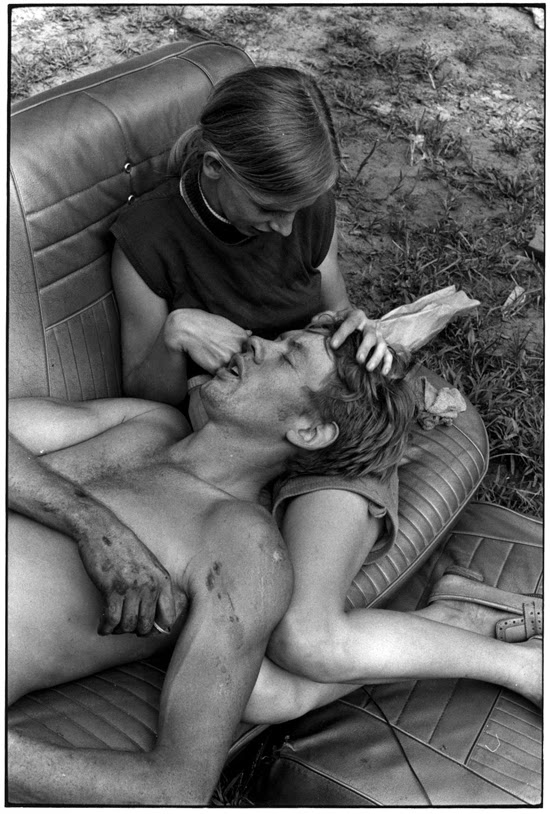
Photographer William Gedney made these pictures of Kentucky mining families in 1964 and
1972. These images, only a few of many more, are from the Duke University Rare Book, Manuscript, and Special Collections
Library, which provides the following description:
"William Gedney made two trips to
eastern Kentucky. In the summer of 1964, he traveled to the Blue Diamond Mining
Camp in Leatherwood, Kentucky and stayed for awhile at the home of Boyd Couch,
head of the local United Mine Workers Union. Then Gedney met Willie Cornett,
who was recently laid off from the mines, his wife Vivian, and their twelve
children. He soon moved in with the Cornett family, staying with them for
eleven days. Twenty-two of the photographs from Gedney's 1964 visit to Kentucky
were included in his one-man exhibition at the Museum of Modern Art in New York
(December 1968 through March 1969). Gedney corresponded with the Cornetts over
many years, and finally returned to Kentucky to visit and photograph the family
again in 1972."
Photographer Roger May, who was
born and raised in Appalachia writes eloquently about Gedney’s work, which I am
happily discovering for the very first time (thanks to my friend Susan). Here
are some excerpts from Roger May’s thoughts on Gedney and his work:
“His work resonates with me on a number of
different levels, but I suppose I'm most impacted by how he chose to look at,
to see Appalachia. It wasn't a one-off way of seeing for him, for he brought
that same quietness, stillness, and earnestness to other parts of the world:
New York, India, San Francisco. The consistency is appreciated. The grace with
which we made note of moments he wanted to remember, wanted to share, needed to
share.
I'm fascinated by his eastern Kentucky
photographs. Try as I may, I haven't been able to figure out why he chose
Appalachia to make photographs, but I'm so very glad he did. Nowhere can I find
the reason that led him to Perry County, Kentucky. In the early 1960's,
Appalachia saw a flood of photographers, news crews and filmmakers (think
Charles Kuralt's Christmas in Appalachia circa 1964) come into the hills and
hollers as part of the War on Poverty campaign. By and large, they formed a
disparaging visual narrative of the place I was born and raised. Yet somehow,
he transcended that tendency and instead made photographs of grace, beauty, and
simple existence all the while capturing the challenging environs of those he
photographed. There must've been something about his spirit that caused him to
see what others did not, would not, perhaps could not.
His journal writing (1964) reveals a keen insight
into some of the region's problems: ‘The region is rugged and isolated, the
people are trapped in a circle of poverty, bad schools, corrupt politics and
unskilled labor etc. Though I do not consider myself a 'social-problem'
photographer, I hope something of this part of America and its people is
conveyed to you."
Gedney's Appalachia work is refreshing to me
because it feels so incredibly real. Margaret Sartor, a photographer, writer,
and teacher at the Center for Documentary Studies at Duke, noted that, ‘We keep
looking because it (Gedney's work) feels so genuine.’ I couldn't agree more.
His unassuming presence allowed him to capture moments so obviously absent from
most of the work I've seen from Appalachia, that one has to wonder why so few
photographs like this exist. Certainly at the time he was photographing in
Appalachia, there was a stream of imagery coming out of there that I feel
shaped the way we look at Appalachia today. For me, Gedney chose to see and
show the deeper humanity of my home. How he saw the world, my world, challenges
me to be truer, to be more authentic when I work.
William Gedney died on June 23, 1989 at 56. In
his lifetime, he was awarded a John Simon Guggenheim Memorial Foundation
Fellowship for photography (1966-67), a Fulbright Fellowship for photography in
India (1969-71), a National Endowment for the Arts grant in photography
(1975-76), and several other grants and fellowships. Four years after his
death, in 1993, Duke University became the repository for Gedney's work.
Margaret Sartor was approached by the Rubenstein Library and asked to put
together an exhibit of Gedney's work. In 2000, she and Geoff Dyer coedited What
Was True: The Photographs and Notebooks of William Gedney.
Gedney's work always commands my attention. It
isn't forceful, overbearing, or gimmicky. He presents grace, beauty and
humanity in a people often marginalized and dismissed. These are things that
are important to me, qualities he captured about the people and place that
means so much to me. He didn't shy away from poverty or hard times, instead he
chose not to make it the focus of his work. Because of that, we get to see
something so few who make photographs in Appalachia can show us. By pressing in
close enough, quietly enough, in the words of Thomas Roma, he captured the
beauty of our sameness.” - Roger May
Labels:
photography,
Roger May,
William Gedney
Subscribe to:
Posts (Atom)