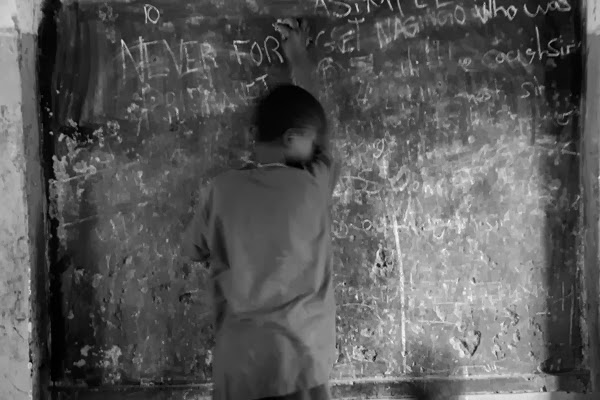
Yesterday during the Photo Scholar class I'm helping teach at the Nelson-Atkins Museum, I made a presentation about photographing as an "outsider." Below you can read what I had to say and see a few of the pictures I shared.
When I went to Uganda for the first time in 2006, I was
as much of an outsider as I could possibly be. Here I was in one of the poorest
countries in the world, surrounded by Christian and Muslim people with very
dark skin who spoke little or no English. Poor sanitation and disease are rampant
in Uganda, and in this one African country alone, there are 2.5 million
orphans.
I am a white, Jewish girl from a comfortable middle
class family, raised in Kentucky. I’ve never truly been hungry. I’ve always
known where I would lay my head at night. I’ve had access to clean water, good
medical care and a loving, supportive family my whole entire life.
On day one of the two-week long photography workshop I
was taking, our teacher gathered us for an orientation meeting. I was still
hung over with jetlag from the long flight, and I was nervous about being in
Africa and being with a group of 15 photographers I’d never met before. After a
brief presentation, he told us all to go down to the curb in front of the
hotel. Within a few minutes, he had rounded up 15 motorcycle taxis, and he instructed
us each to hop on one. My heart was racing. No helmets, no idea where we were
going and no introduction to the very black man around whose waist I had
suddenly wrapped my arms.
 |
| Thatcher, my teacher, totally in his element |
 |
| me: terrified but excited |
We flew through the streets of Kampala, weaving our way
around cars and pedestrians. I quickly realized the next two weeks was going to
be the most exhilarating experience I’d ever had. I decided right then, on the
back of that motorcycle, that I was going to dive into Uganda head first and as
fully as possible. Why else venture so far from home?
Our teacher took us to a huge outdoor market and told us
to go in and make pictures - that we should return to our motorcycles in half an
hour. The market was wall-to-wall people – a sea of bodies pressing against
each other. The sounds and the smells were overwhelming. I was terrified, and I
was thrilled beyond belief. As soon as I started making my way through the
crowd, my camera poised for action, people started calling out “Muzuungu!
Muzuungu!” I was such an outsider I didn’t even know what the word meant (slang
for white person I found out later). I managed to shoot a few pictures, but
mostly I was overcome with the realization that - other than my classmates, who
had been swallowed up by the teeming crowd in a matter of minutes, I was the
only Caucasian in sight.
How does one even begin to make images of a place and a
group of people that are miles beyond her understanding? And why should she even
try? How could I possibly begin to tell the stories of the people around me? But
wasn’t that the reason I had come to Africa in the first place?
Of course, I couldn’t really tell anyone’s story that
day. All I could do was tell my own: my trepidation, my curiosity, my eagerness
and my excitement definitely showed through in the pictures I made that day
(unfortunately all of those pictures except one very small digital file were
lost when my laptop was stolen a few days later).
I think the whole point of the assignment was to make us
dig deep and consider what we, as photographers, were really made of. How
willing were we to step outside our comfort zones? If we were willing stretch ourselves, how would we navigate that
new terrain, and what kind of pictures would we ultimately want to make?
The next day, I went to a boxing gym to make pictures.
Rather than hang on the sidelines, I got right in the middle of the action,
making it clear I was there because I was a serious artist and that I was highly
respectful of the men and women training there. There was a lot of joking
around, too. I had recently been doing some kick boxing back home, and I showed
them some of my moves. I think that made them feel more comfortable having me
there. I just kept it honest and respectful and loose and fun.
A couple days later, we boarded a rickety old bus headed
for the southwestern part of the country. After a daylong drive, we arrived at
a very small, rural village where no one spoke English. Each of us was assigned
to a family, with whom we would spend the next three days. My family consisted
of Margaret and her several young children, nieces and nephews. She farmed a
small piece of land behind their mud hut.

So, we couldn’t communicate with one another verbally –
only nods and smiles and a lot of pointing. The first thing I realized was that
it was best to leave my camera in its bag until we all figured out a way to
feel comfortable around each other. Remarkable things started to happen once I
just let myself BE with them… sharing a meal, kicking a beat up old soccer ball
around with the kids, walking with them to the water hole, meeting and greeting
the family goat. We all opened ourselves to each other, because we were curious
(these kids were not accustomed to seeing a Muzuungu) and well, we eventually
figured out we were all just regular old human beings.
When I did bring out my camera, they were fascinated by
it. The novelty wore off after a bit, though, and then they didn’t pay much
attention to it. I was able to make pictures without the kids hamming it up or
even feeling self-conscious because it was clear that I was truly interested in
what they were doing at any given moment.
I tried not to let my camera come between us as we
forged our relationships. And because I was not a threatening presence, the
family went about its business – eventually forgetting I was even shooting
pictures. (Examples of this work are few, because most of those, too, were stolen along with my laptop.)
My next overwhelming assignment was to do an extended
body of work at one particular NGO. Mine was St. Mary Kevin Orphanage
Motherhood, a place I innocently entered one day thinking I’d just take some
pictures and leave. Little did I know this would be a place I would return to
year after year. It has taken time and patience to gain the full trust of the
people there. I am still an outsider, but maybe not quite as much as I was in
2006.
These first two pictures reveal the mistrust that was
evident on some of the kids’ faces. Who could blame them? But as the days went
by, and we began to know one another, I was able to make pictures that were
less about me being a voyeur and more about me being an image-maker and a storyteller.
So here are my tips for you to consider as you make your
own outsider photographs:
- Don’t greet your subjects with your camera. Greet them
with your hand extended.
- Do what you can to make them feel comfortable around
you.
- Be respectful. Treat your subjects with dignity.
- Establish some kind of rapport before you even start
shooting.
- Let your subjects know somehow that you are in this
together; it’s a dance, a collaboration of sorts.
- Understand that nothing will change the fact that you
are an outsider.
- Realize that because of that context, your pictures
will take on an importance and meaning of their own. So embrace it.
- Remember that while you are telling their story, you
are also telling your own.
In the end, the stories I’m telling are all from an
outsider’s point of view. How could they be anything else? The challenges
inherent in making images so far removed from my own reality have taught me a
lot about a different culture, and in turn… a lot about myself. The fact that these are outsider photos,
and nothing I can do will really ever change that, ultimately helps define what
this body of work is all about.
My two cents. For what it's worth.